EMS Microcrystal Infusion Devices: How They Work and What to Specify
Micro-channel delivery combined with microcurrent: tip geometry, the fluid path, intensity levels and the consumable business model.
March 21, 2026 · Updated June 2, 2026 · 5 min read
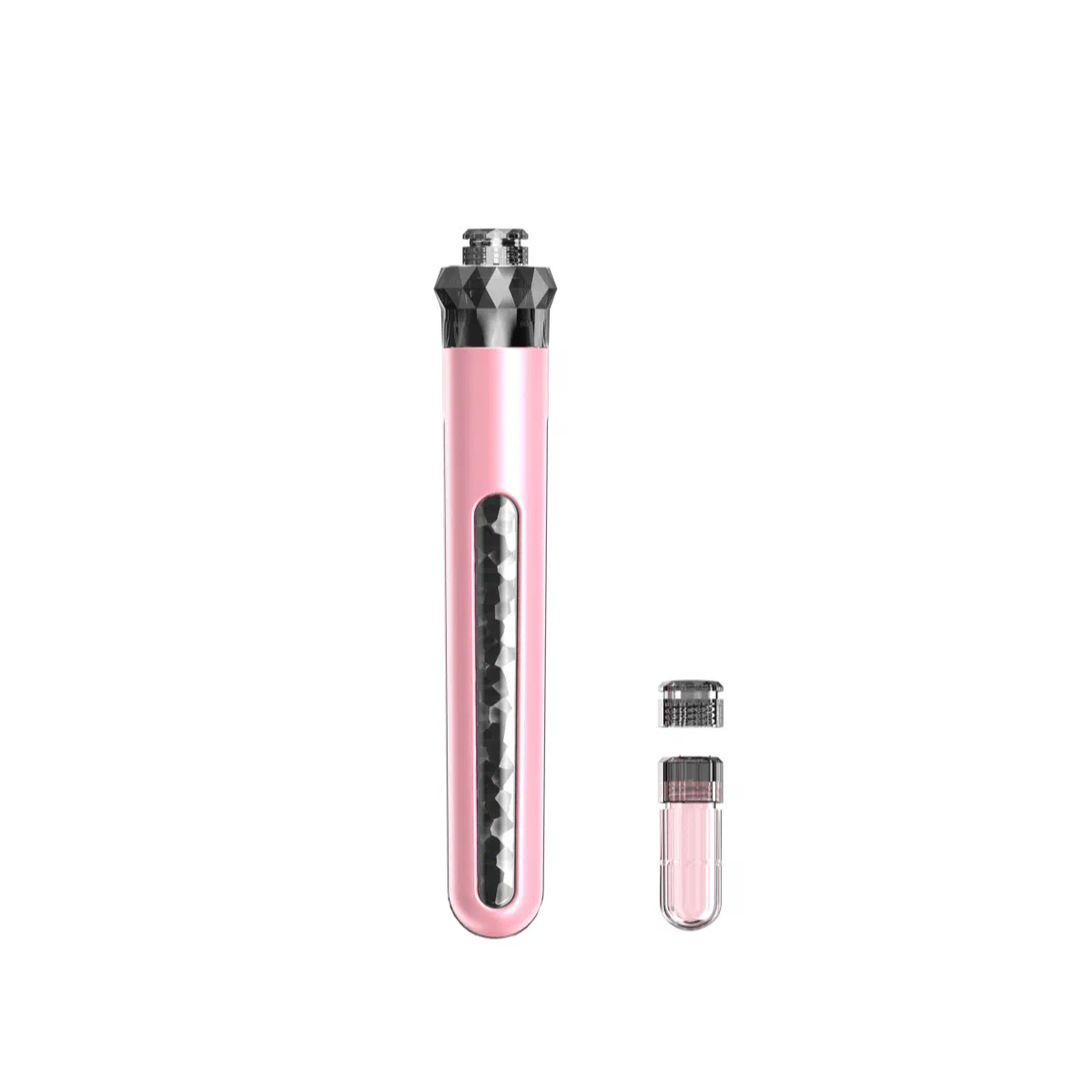
Microcrystal infusion devices are the part of the home beauty category closest to a medical principle: create temporary micro-channels in the outer skin layer so a serum reaches below the surface, then close the channels and let the skin recover.
Adding microcurrent to that is not decoration — it is a second, independent mechanism aimed at the same goal, absorption. But it also doubles the engineering surface, and that is where most projects go wrong.
What “microcrystal” means mechanically
A microcrystal tip is a dense array of short, conical structures. Pressed against the skin, they create channels in the stratum corneum without reaching nerves. The design variables that matter:
- Tip height and density — depth consistency across the array, not just peak depth
- Tip material — dissolving, silicon, metal or plated structures behave differently and have different regulatory positions
- Pressure distribution — a flexible substrate spreads load; a rigid one concentrates it
- Reusability — a reusable tip needs a cleaning protocol; a disposable one does not
Consistency across the array matters more than maximum depth. A tip that penetrates 0.15 mm in the centre and 0.05 mm at the edge delivers an uneven treatment, and users notice uneven results before they notice anything else.
The fluid path is the hard part
Most failures in this category are fluid problems, not electronics problems. Serum viscosity varies between products; the delivery path has to hold a stable flow from a full cartridge to a nearly empty one, without clogging, and without air entering.
The three components that decide it:
- The interface between cartridge and tip — the most common source of leaks and of incompatibility with third-party serum
- The pressure source — motor-driven or pump-driven, with different flow stability profiles
- The venting — a sealed cartridge that does not vent will starve as it empties
If a client arrives with an existing serum, the first engineering task is not the device; it is characterising the serum. We have rebuilt fluid paths around a specific viscosity more than once.
Intensity levels: fewer, better
EMS in an infusion device usually runs at modest intensity, because the point is absorption rather than contraction. The detail users feel is the step size, not the maximum.
Good practice, and what we design to:
- The first step should be perceptible but not startling
- Steps should be roughly even in perceived intensity, not in electrical output
- The device should not reset to maximum after a pause
Tip formats: face, lips, and when a specialised tip earns its cost
Most infusion devices ship with one tip geometry and treat the face as a single zone. That works until a brand wants to treat an area where the geometry does not fit — lips being the obvious case.
A lip tip is a different design problem, and the details are worth understanding because they show what “specialised” actually requires:
- A narrower wafer. A wafer in the 10 × 5 mm range follows the lip line; a face-sized tip cannot.
- A contoured substrate. A wave-shaped TPE outline lets the tip follow the lip contour without pressing, which matters because the area is sensitive.
- A central outlet. Delivering serum through the centre of the tip rather than from the edge keeps the fluid where the channels are.
- Material choice. Monocrystalline silicon gives uniform structure across the wafer, which is what makes depth consistent.
The commercial logic: a specialised tip is a second SKU with its own consumable, and it lets a brand sell a targeted treatment rather than a generic one. The engineering cost is a new wafer and a new housing interface — real, but far below a new device.
The consumable is the business model
In this category the device is often sold at a thin margin and the tip or cartridge carries the recurring revenue. That changes the engineering brief in ways worth being explicit about:
| Decision | Effect on the device | Effect on the business |
|---|---|---|
| Disposable tip | Simpler hygiene, lower device cost | Recurring revenue, higher user cost |
| Reusable tip | Lower user cost, needs cleaning protocol | Weaker repeat purchase |
| Proprietary cartridge | Better flow stability | Locks the user in, alienates some brands |
| Standard cartridge | Flexible for the brand’s own serum | Harder to guarantee flow |
There is no universally correct answer, but the decision should be made at the start, because it drives tooling and certification scope.
What to specify
A specification for an infusion device should state:
- Tip type, height, density and reusability
- Compatible serum viscosity range
- Flow rate and stability across the cartridge
- EMS intensity range and the number of steps
- Charging, runtime and IP rating
- Consumable packaging and sterility approach
- Target market, and therefore the certification route
How it fits with your product line
Infusion devices work commercially as a companion to a serum, because they increase repeat purchase of something the brand already sells. We develop them as platform devices (adapt the housing, colour and firmware) or as custom builds.
The microneedling and infusion range lists the platforms we currently produce, and the technology page covers the underlying principle.
Failure modes we see in the field
Four problems account for most warranty returns on infusion devices, and all four are decided at design time rather than at assembly.
Clogging at the tip interface. Serum dries in the interface between uses. A design that cannot be flushed clean will clog, and the user will report it as “the device stopped working” rather than as a maintenance problem. Design the interface for cleaning, and write the cleaning step into the manual.
Cartridge starvation. As a cartridge empties, a path without adequate venting starts to draw air. The visible symptom is a sputtering, inconsistent delivery in the last quarter of the cartridge — exactly when the user is judging whether the product is worth rebuying.
Tip wear that users cannot see. Microcrystal tips degrade. If the wear is invisible, the user keeps using a tip well past its effective life and the results quietly decline. Either make wear visible or enforce a usage count in firmware.
Contact inconsistency. If the device delivers current without checking that the tip is properly seated, output varies with how the user holds it. Contact detection is cheap; the reputational cost of inconsistent results is not.
Designing against these costs less than the returns they prevent, but only if they are considered before tooling.
Have a serum that needs a delivery device? Tell us the viscosity and the fill format and we will tell you which platform is compatible before any tooling is discussed.